 Family Bitcoin
Money that nobody can print more of
A kitchen-table lesson for parents and kids. We start with a money problem you hear in the news, then walk through what bitcoin is, how sending it works, and why keeping the keys safe matters.
Heard this lately?
Politicians promise cash payments. Debates flare about raising the debt ceiling. Headlines say the national debt keeps growing. A fair family question follows: where does that money come from?
Often it means the government borrows more — and the total pile of dollars owed grows. As of October 26, 2026, U.S. total public debt outstanding was about $40.53 trillion.
Source: U.S. Treasury Fiscal Data — Debt to the Penny (record date 2026-10-26).





Around the table: “If they can make more dollars… what holds its value?”
Money that can grow forever
When more dollars are created or borrowed into existence, each dollar can buy a little less over time. Your family’s savings have to run harder just to stay in place.
Bitcoin’s fixed supply
Bitcoin is digital money with a hard cap — only so many coins will ever exist (just under 21 million). No company or country can mint “extra” bitcoin the way new dollars can appear.
So what is bitcoin, in plain words?
Think of a shared notebook that anyone can check, but nobody owns. That notebook is called the blockchain — a public list of who sent bitcoin to whom. Computers around the world keep matching copies, so one person can’t quietly rewrite the past.
You don’t need a bank account to hold bitcoin. You need a wallet (an app or a small device) that holds your keys — secret codes that prove the coins are yours and let you send them.
 Dad: “It’s money the whole world can check.”
How sending and receiving works
Sending bitcoin is a bit like writing a check that the whole network can verify — without mailing paper.
You open your wallet
Your wallet shows an address (like an account number you can safely share) for receiving, and it holds the keys for sending.
You send a little bitcoin
You type how much and where it should go. The wallet uses your keys to sign that send — like a digital signature only you can make.
The network checks it
Computers on the bitcoin network confirm the send and write it into the shared notebook. After that, it’s hard to undo — which is why families practice with small amounts first.
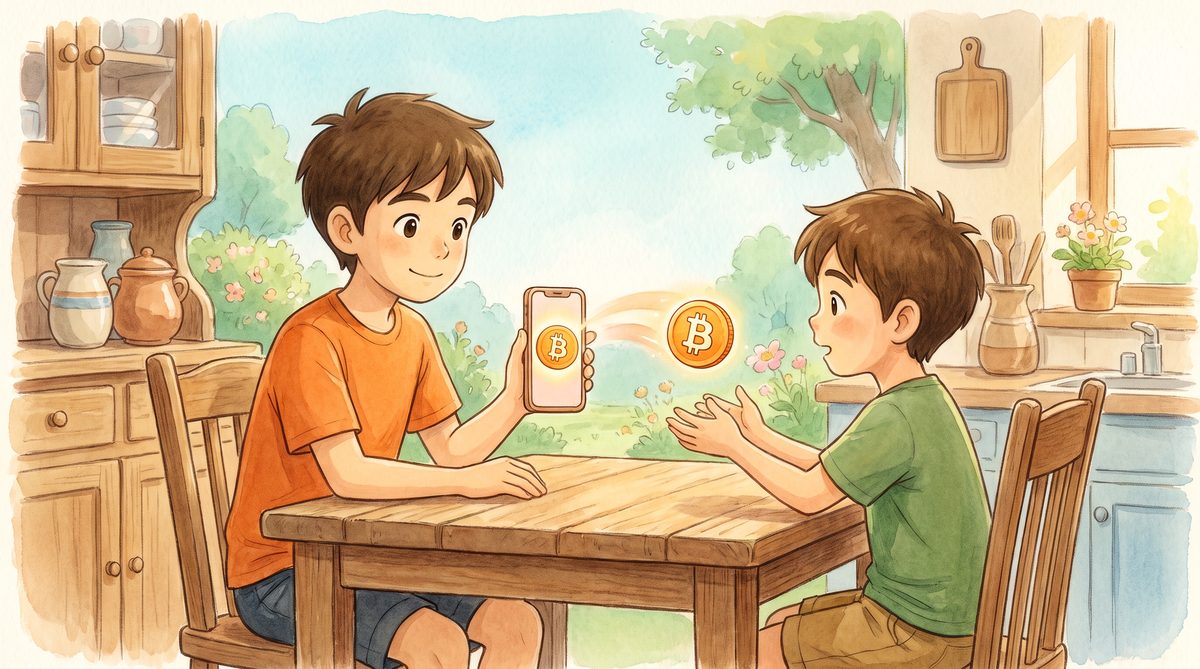 Passing value — phone to phone
 Keys stay with the family
Why scarcity and keys matter
Scarcity just means “there isn’t an endless pile.” Bitcoin’s rules cap how many coins can ever exist. That’s different from money a government can create more of when it needs to spend.
Keys are how you prove ownership. Lose the keys (or the backup words that rebuild them) and those coins are gone — even for you. Share the keys carelessly and someone else can move the coins. So families treat keys like house keys, only more carefully.
 Only so many coins in the jar
Talk it through as a family
If someone can create more of a money whenever they want, what happens to the money you already saved? How is bitcoin’s “fixed jar” different?
What to learn next
This page is the warm start. When you’re ready for deeper how-tos — wallets, backups, passphrases, security — our sister site Cold Hard Sats has intermediate and advanced lessons written for adults who want more detail.
Keep going on Family Bitcoin
Passphrase wallets for families — one seed backup, separate wallets for each person.
Go deeper on Cold Hard Sats
Soft next steps when the kitchen-table version isn’t enough:
Seed phrase backup guide · Passphrase / seed phrase math · coldhardsats.com
Family Bitcoin is educational storytelling for families. It isn’t financial, legal or tax advice. Debt figure from U.S. Treasury Fiscal Data (Debt to the Penny), record date 2026-10-26. Bitcoin’s supply rules are set by the open protocol; wallets and menus differ by software.